
The Timeline You Want vs. The Timeline Your Video Needs
Every video project starts with the same conversation.
“How fast can you turn this around?”
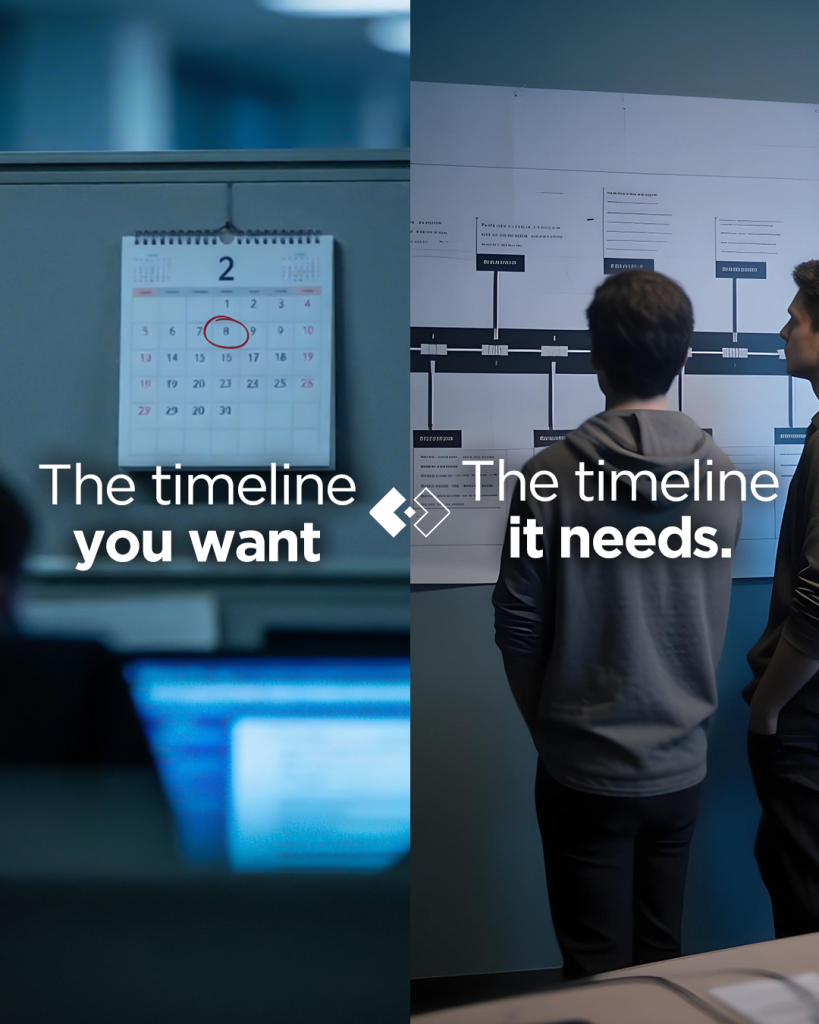
It’s a fair question. Deadlines are real, campaigns have launch dates, and nobody wants to sit on finished footage longer than necessary. But somewhere between the timeline a client wants and the timeline the work actually needs, things have a habit of going sideways.
Not because studios are slow. Not because clients are impatient. Because video post-production is more complicated than it seems from the outside, most timeline problems begin before a single frame gets edited.
This is an honest breakdown of what a realistic post-production timeline looks like, where time actually goes, and how to build a schedule that doesn’t fall apart three weeks in.
How Long Does Post-Production Take? A Realistic Look.
The honest answer is: it depends. But that’s not helpful, so here’s a more grounded version.
For a typical two to three-minute marketing or brand video with interviews, b-roll, motion graphics, and a few rounds of revisions, two to four weeks is a reasonable post-production window. A more complex project with heavier animation, sound design, or multiple deliverable formats can run four to six weeks or longer.
Here’s what that time is actually covering:
Rough cut and structural edit. This is where the story gets built. The editor works through all the footage, makes structural decisions, and assembles a first version that reflects the brief. For a two to three-minute video, this alone can take three to five days, sometimes more if the footage is heavy or the brief left room for interpretation.
Client review and feedback. A standard post-production process includes two to three rounds of revisions. Each round involves the client reviewing the cut, consolidating notes, and the editor implementing changes. Realistically, each round takes two to four days, not counting the time it sits waiting for internal sign-off on the client side.
Color grading. This is not a finishing touch. Color grading shapes the mood, consistency, and visual identity of the entire piece. A properly graded two-minute video takes one to two days minimum. Rushed color shows.
Sound design and audio mixing. Music selection, audio balancing, voiceover integration, sound cleanup. This phase is easy to underestimate and hard to fix after the fact. Budget at least one to two days for anything beyond a simple cut.
Final export and delivery. Different formats for different platforms, final quality checks, and file delivery. Usually a day, sometimes more if the deliverable list is long.
Add it up, and a two-week window starts to look tight very quickly.
The Hidden Timeline: Why Internal Approvals Are Usually the Bottleneck
Here is something most clients don’t realize until they’ve been through the process a few times.
The studio is rarely where time disappears.
The edit gets done. The color is locked. The sound is mixed. And then the file sits in someone’s inbox waiting for a stakeholder who is traveling, or a legal team that needs three days to review a script, or a brand manager who needs to loop in someone from another department before they can approve.
A real example of how this plays out: a studio delivers a first cut on day eight of a three-week timeline. The client needs a sign-off from three people internally before they can send consolidated feedback. That process takes six days. By the time notes arrive, the project is already behind, and the remaining revision rounds are being squeezed into a window that was never designed to hold them.
This is not a complaint about clients. It is just the reality of how organizations work. Approvals take time, and that time needs to be inside the timeline, not on top of it.
The fix is simple: map out your internal approval process before the project starts. Who needs to review each round? How long does sign-off realistically take? Is legal involved? Does the CEO need to see it? Build that into the schedule from day one, not as an afterthought when the first cut lands.
What Actually Happens When You Rush Post-Production
Rushing post-production does not just affect quality in an abstract way. It affects very specific things, and they are usually the things that matter most.
Feedback becomes reactive instead of considered. When a client has 24 hours to review a cut that needs three days of attention, the notes reflect that. They are surface-level, sometimes contradictory, and often miss the structural issues that actually need addressing. The editor implements what was asked for, the underlying problem remains, and a fourth revision round gets added to a timeline that only had room for three.
Creative decisions get made under pressure. Color grading done in a few hours instead of a day looks different from color grading done properly. Music choices made at 11pm to hit a morning deadline are different from music choices made with time to actually listen. These are not dramatic differences in isolation. But they compound across a whole project.
The brief stops being the reference point. When time is short, the question shifts from “does this serve the brief?” to “does this get us to delivery?” Those are very different questions, and the work reflects whichever one is being asked.
The relationship suffers. A studio rushing to meet an unrealistic deadline is operating under stress. A client that recieves work that feels unfinished is a client who loses confidence. Neither party gets what they actually wanted, and the next project starts with a layer of tension that did not need to be there.
How to Build a Post-Production Timeline That Actually Holds
A realistic video production schedule for post-production is not complicated. It requires accounting for what is actually happening, not an optimistic version of it.
A few things that consistently help:
Start with the delivery date and work backwards. Lock the date the video needs to be live or in-hand. Then map each phase of the post-production process backwards from there. If the phases do not fit, the delivery date needs to move, or the scope needs to be adjusted. Discovering this at the start is far less painful than discovering it during round three.
Add a buffer to every review round. If you think a review round will take two days, plan for four. Not because anyone is being inefficient, but because things come up. Stakeholders get pulled into other priorities. Feedback takes longer to consolidate than expected. A two-day buffer on every round is cheap insurance.
Separate creative revisions from technical fixes. Creative revision rounds, where the structure, pacing, or messaging is being refined, take longer and need more thoughtful attention than technical fixes like a title card correction or a music level adjustment. Treating them as the same thing leads to scopes that do not make sense.
Have the approval chain conversation before production starts. Who are all the people who will need to sign off on this? In what order? What is their typical response time? This conversation feels administrative, but it is actually one of the most important planning conversations a production has.
Fast and Rushed Are Not the Same Thing
A realistic video production schedule for post-production is not complicated. It requires accounting for what is actually happening, not an optimistic version of it.
A few things that consistently help:
Start with the delivery date and work backwards. Lock the date the video needs to be live or in-hand. Then map each phase of the post-production process backwards from there. If the phases do not fit, the delivery date needs to move, or the scope needs to be adjusted. Discovering this at the start is far less painful than discovering it during round three.
Add a buffer to every review round. If you think a review round will take two days, plan for four. Not because anyone is being inefficient, but because things come up. Stakeholders get pulled into other priorities. Feedback takes longer to consolidate than expected. A two-day buffer on every round is cheap insurance.
Separate creative revisions from technical fixes. Creative revision rounds, where the structure, pacing, or messaging is being refined, take longer and need more thoughtful attention than technical fixes like a title card correction or a music level adjustment. Treating them as the same thing leads to scopes that do not make sense.
Have the approval chain conversation before production starts. Who are all the people who will need to sign off on this? In what order? What is their typical response time? This conversation feels administrative, but it is actually one of the most important planning conversations a production has.
There is nothing wrong with wanting a quick turnaround. Some projects genuinely move fast, and a clear brief, organized assets, and a responsive client can compress a timeline significantly without sacrificing quality.
The problem is not speed. The problem is when a timeline gets built around what everyone hopes will happen rather than what the process actually requires.
A video produced in two weeks with a clear brief, a tight scope, consolidated feedback, and a pre-aligned approval chain can be excellent. A video produced in two weeks, where none of those things exist, will show it.
The difference between fast and rushed is not how much time you have. It is whether the time you have was planned honestly.
Build the timeline around the work. The work will reflect it.