
The Problem Isn’t Attention Span — It’s Relevance
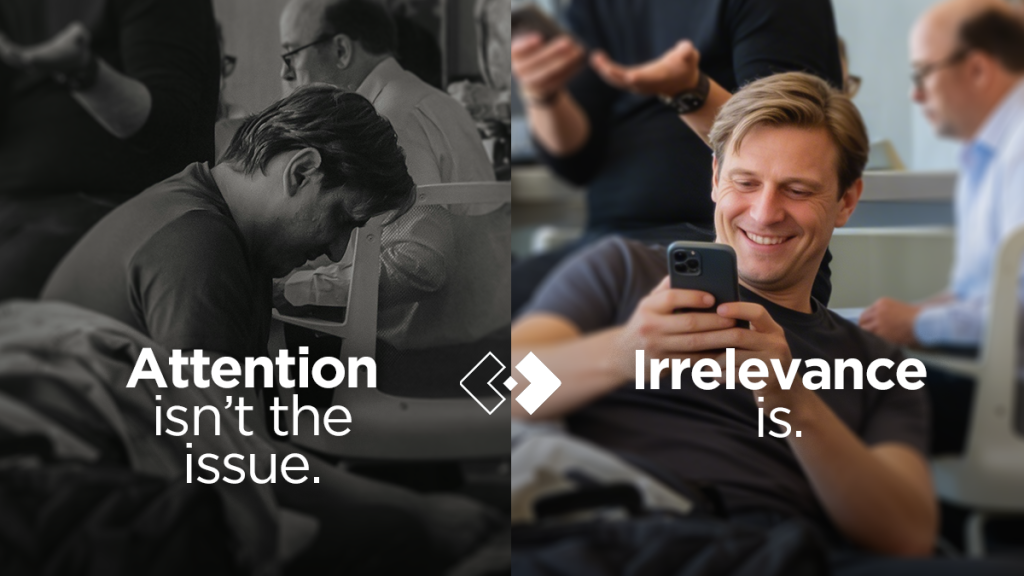
The Myth: “People Don’t Watch Long Videos Anymore”
The Truth: Audiences Watch What Feels Relevant
Where Relevance Comes From?
Relevance doesn’t happen by accident. It comes from a few simple decisions made early — before anyone hits record or opens a timeline. When a piece connects, it’s usually because four things were clear from the start.
- 1. A Specific Audience
Content made for “everyone” lands with no one. Relevance begins with narrowing the target: a creative director juggling multiple campaigns, a brand manager under pressure to deliver ROI, a founder trying to articulate a story. When the viewer recognizes themselves in the framing, they lean in.
Signal:
The viewer can answer, “This is about my world.” within seconds.
- 2. A Real Problem
Attention follows pain. If the story doesn’t surface a meaningful tension — a challenge, a desire, a gap — there’s no reason to care. Relevance increases when the content names a problem the viewer already feels and shows that you understand its stakes.
Signal:
The viewer thinks, “Yes, that’s exactly the issue I’m facing.”
- 3. A Point of View
Information alone rarely holds attention. POV is what turns information into insight — a perspective on how to think about the problem, what matters, and what doesn’t. It’s the difference between a generic explainer and a piece that actually influences decisions.
Signal:
The viewer hears, “Here’s what we believe — and why.”
- 4. A Structure That Respects Logic
Relevance fades when a story wanders. Using a clear narrative spine setup → tension → resolution helps the viewer follow the logic and understand why each moment exists. It’s not about being cinematic; it’s about making the information effortless to process.
Signal:
The viewer never wonders, “Why am I seeing this?”
None of these elements depend on runtime. They depend on intention. A 20-second clip can be highly relevant if it speaks to a clear problem with a clear POV; a three-minute film can collapse if it tries to say everything to everyone.
The First 3–8 Seconds: Earn the Next 30
Most viewers don’t decide to watch a video — they decide not to.
The opening seconds are where that judgment happens. Before story, before pacing, before craft can do its work, the viewer is asking one thing:
“Is this for me?”
That’s why hooks matter more than intros. An intro tells you where you are; a hook tells you why you should care. In a world of infinite choice, viewers don’t wait around to find the point — they need to feel it immediately.
A strong opening does three jobs fast:
1. Signals who it’s for
The viewer should recognize themselves — their role, context, or problem.
2. Makes a clear promise
What will they learn, feel, or understand if they stay?
3. Establishes direction
The piece should feel like it’s going somewhere intentional, not wandering.
A hook isn’t clickbait; it’s clarity delivered early. It can be a problem statement, a surprising insight, a visual cue, a before-and-after, a bold perspective — anything that creates orientation and forward pull.
For example:
- Problem-first:
“Most event recaps look great — but don’t move anyone who wasn’t there.”
- Unexpected claim:
“Short videos don’t perform better. Relevant ones do.”
- Context cue:
A quick visual setup that shows the world we’re stepping into.
None of this is about speed for its own sake.
It’s about respect — acknowledging the viewer’s time by proving quickly that you’re here to deliver value. When the opening establishes relevance, viewers relax. They’re willing to stay because they know what they’re staying for.
If those first seconds fail to make a connection, even 15 seconds feels long. If they succeed, the next 30 — and often much more — come naturally.
The first few seconds don’t need to be flashy; they need to be purposeful. Their only job is to earn the next slice of attention.
Structure That Holds Attention (Even When Long)
Relevance gets people in the door. Structure keeps them there.
A video doesn’t need to be fast to feel engaging — it needs to feel like it’s going somewhere. When viewers sense momentum and clarity, they stay with you, even through deeper or slower moments. When they can’t tell why something is on screen, attention fades quickly.
Good structure isn’t about being cinematic or dramatic. It’s about logic: helping the viewer follow the thread without working for it.
Most effective pieces — from brand films to explainers — share a simple spine:
1. Setup
Establish the world, context, or problem.
Show the viewer what’s at stake and why this story exists.
2. Tension
Introduce the challenge, friction, or question that needs resolution.
This is what keeps viewers engaged — they want to see how it plays out.
3. Resolution
Show the shift — the insight, change, or outcome that answers the central tension.
Videos lose people when they:
- Try to say everything
- Jump between unrelated ideas
- Stay too surface-level
- Offer information without perspective
- Deliver scenes that look good but mean nothing
When every moment has a job, viewers rarely feel lost. They understand why they’re seeing what they’re seeing, and they’re willing to follow because the story keeps rewarding their attention.
This is true across formats:
– A brand film uses structure to reveal a belief or transformation.
– An explainer uses structure to clarify a problem and its solution.
– An aftermovie uses structure to turn a sequence of events into an emotional arc.
It makes even longer pieces feel effortless because the viewer always understands where they are in the journey.
When Short Is the Right Answer
Just because length isn’t the enemy doesn’t mean every video should be long.
Short form has a clear place — and when used intentionally, it’s incredibly effective. The key is understanding **when brevity serves the story and the viewer.**
Short works best when the message is simple, the audience is cold, or the next step is small.
Here are the scenarios where short is the right call:
1) Cold Audiences
If viewers don’t know your brand yet, they’re not ready for depth.
They need orientation, not immersion. Short content helps establish familiarity and gives them an easy “yes” — a low-effort way to understand who you are and what you do.
2) Low-Complexity Messages
Some stories just don’t need that much runway.
A quick announcement, a single idea, a concise demo — stretching these to fill time doesn’t add value, it dilutes it.
3) Fast-Moving Campaigns
When the priority is agility — reacting to a moment, supporting a launch, or reinforcing a message already in market — shorter assets help teams move quickly without getting bogged down in production cycles.
4) Conversion Moments
At the bottom of the funnel, the viewer often just needs clarity — a nudge toward a decision. Short pieces give them exactly what they need to take the next step without distraction.
Short = efficient, not shallow.
It still needs focus, intention, and a point of view. If it doesn’t speak to someone, solve something, or say something, it won’t work — no matter how quick it is.
Decision-Maker Checklist: Designing for Relevance
Here’s a simple checklist teams can use to design — and later evaluate — relevance with intention:
1) Who is this for?
Not a demographic — a role, a context, a situation.
If you can’t describe the viewer clearly, you can’t speak to them clearly.
A creative director preparing quarterly campaigns” is better than “People interested in video.”
2) What problem are we helping them solve?
Relevance follows pain.
Name the challenge they’re already feeling — budget pressure, speed, clarity, differentiation, etc.
If there’s no problem, there’s no reason to care.
3) What’s the POV?
What do we believe about the problem?
What are we saying that someone else wouldn’t say the same way?
A strong POV separates signal from noise.
4) What must be communicated in the first 5–10 seconds?
The opening decides whether they stay.
This is where we make the promise:
“This is about your world — here’s why it matters.”
If the opening could belong to any video, it’s too vague.
5) What’s the narrative spine?
Even simple pieces need direction.
Setup → tension → resolution.
If any moment doesn’t serve that movement, cut it.
The viewer should never wonder why they’re seeing something.
6) What’s the action or next step?
What should the viewer do with the information — think, feel, ask, request, share?
Relevance has a destination. Even a soft next step creates clarity. This checklist doesn’t slow teams down — it prevents wasted cycles.
When these questions are answered early, production is smoother, reviews are faster, and the final piece does what it’s supposed to: connect.
What Changes in Your Next Brief
If relevance is the real driver of attention, then the brief can’t just describe *what* needs to be made — it has to clarify why it matters, and to whom.
A stronger brief doesn’t add work. It cuts ambiguity, misalignment, and wasted iterations.
Length no longer leads the conversation.
The question shifts from “How long should this be?” to “What does the audience need to understand or feel to take the next step?”. Runtime becomes a consequence of purpose — not a starting constraint.
Audience clarity becomes non-negotiable.
A useful brief defines the viewer’s role, priorities, and pressure points. When teams understand who they’re speaking to, tone and structure fall into place much faster.
The problem gets named upfront.
Every compelling story starts with tension. If the brief doesn’t articulate what’s at stake, the piece has nothing to hold onto — and the viewer has no reason to stay.
The opening becomes intentional.
Instead of polishing intros, teams decide early what promise needs to be made in the first few seconds — and how clearly it can be delivered.
Structure becomes a planning tool.
Setup → tension → resolution isn’t just a storytelling idea — it’s a way to organize thinking. When a brief outlines how the narrative should progress, edits become clearer and reviews faster.
Deliverables follow the journey.
Rather than defaulting to “a main video + a few cutdowns”, teams consider where the viewer will encounter the message — and at what stage — so assets align with reality: hero cut, teasers, follow-ups, retargeting pieces. Relevance is reinforced across touchpoints, not left to chance.
The result is a smoother process:
- fewer unclear notes
- fewer revisions
- final piece that actually moves viewers
Because it was designed for them from the start.
Why Relevance Matters More Than Runtime
Attention isn’t disappearing.
It’s just becoming more selective.
Viewers aren’t rejecting long videos — they’re rejecting content that never proves why it matters to them. When the story speaks to a specific audience, solves a real problem, and makes its promise early, people stay. They stay because relevance gives them a reason to.
This is the shift. Stop asking how short a piece can be, and start asking how clearly it serves the viewer. Length is simply the byproduct of purpose — not a measure of effectiveness.
Brands who embrace this create work that holds attention, earns trust, and moves people to act. Because when content feels like it was made *for me*, time becomes flexible.