
AI Filmmaking in 2026
What's Actually Possible Right Now (And What Still Isn't)
A grounded look at the tools, the use cases, and the line between AI-assisted and AI-generated work.
A producer asked us recently if AI filmmaking was going to put studios like ours out of business. We answered with a question of our own: what do you mean by AI filmmaking?
She paused. That’s almost always the answer.
The term gets used to mean wildly different things. Auto-transcription is “AI.” Generating a fully synthetic 20-second cinematic shot is also “AI.” Color matching across cameras is “AI.” So is creating an entire ad campaign without a single frame of live footage. These are not the same thing. They don’t cost the same, they don’t carry the same risk, and they don’t sit in the same place in a production pipeline.
Most of the bad decisions being made about AI in video right now come from this confusion. So let’s clear it up.
Where the tools actually are in 2026
Generative video has crossed a real threshold in the past eighteen months. The leading models, including Sora 2, Veo 3, Kling 3, and Runway, can now produce 20-second cinematic shots from a prompt with detailed control over camera movement, blocking, and pacing. Water behaves like water. Cloth folds correctly. Hands are mostly fine. Character consistency across multiple scenes, which was a fantasy in early 2024, is now a baseline expectation.
What this means in practical terms: the output quality is now good enough to use professionally for the right applications. Not all applications. The right ones.
The cost shift has been just as dramatic. Industry data puts traditional video production at roughly 4,500 USD per minute. AI-assisted production sits around 400 USD per minute. The compression of timelines is even sharper. A 60-second marketing video that used to take around 13 days now takes hours.
That sounds like the end of traditional production. It isn’t. It’s a redrawing of where the value sits.
What AI is actually good at right now
There are five categories where AI tools are working at a professional level today.
The first is concept visualization. Style frames, mood references, pre-visualization of complex shots before an expensive shoot. This used to take a small art department. Now it takes an afternoon. The savings flow into the actual production budget.
The second is custom B-roll. The stock footage market is being quietly disrupted because there’s less reason to license generic footage when you can generate something specific to your brief. The quality bar isn’t quite there for hero shots, but for supporting visuals it absolutely is.
The third is localization. One master piece, dozens of versions for different regions, languages, and audiences. AI handles the variations while the human team protects the master.
The fourth is anything labeled “surreal,” “impossible,” or “stylized.” Scenes that used to require a VFX budget are now within reach for a fraction of the cost. The Kalshi NBA Finals ad in 2025, made for around 2,000 USD in two days using Veo 3, was the proof of concept the industry needed.
The fifth is the back-end work most clients never see. Auto-transcription, rough cut assembly, color matching across cameras, audio cleanup, frame interpolation. None of this is glamorous, but all of it used to eat hours that now go into actual creative decisions.
What AI still can't do reliably
Here’s the part that gets glossed over in most “AI is taking over” articles.
You still cannot reliably generate a two-minute branded piece with a coherent narrative, a specific product rendered accurately, and a client’s exact brand guidelines, and have it pass without a human team in the loop. Not yet. Probably not this year either.
You cannot generate dialogue that lands emotionally without significant human direction.
You cannot replace the editorial judgment that decides which take to use, when to hold a beat, when to cut. The tools generate options. They do not make decisions.
You cannot replace the colorist who knows that a slightly warmer skin tone in shot four matches the warmth of the brand. You cannot replace the sound designer who knows that the silence before a logo lands is more important than the music after it.
And you cannot replace the producer who manages the relationship with the client, the legal review, the brand approval, the disclosure requirements that are about to become regulatory in major markets.
What you can do is make all of those people significantly faster and significantly more useful.
Where the line actually sits
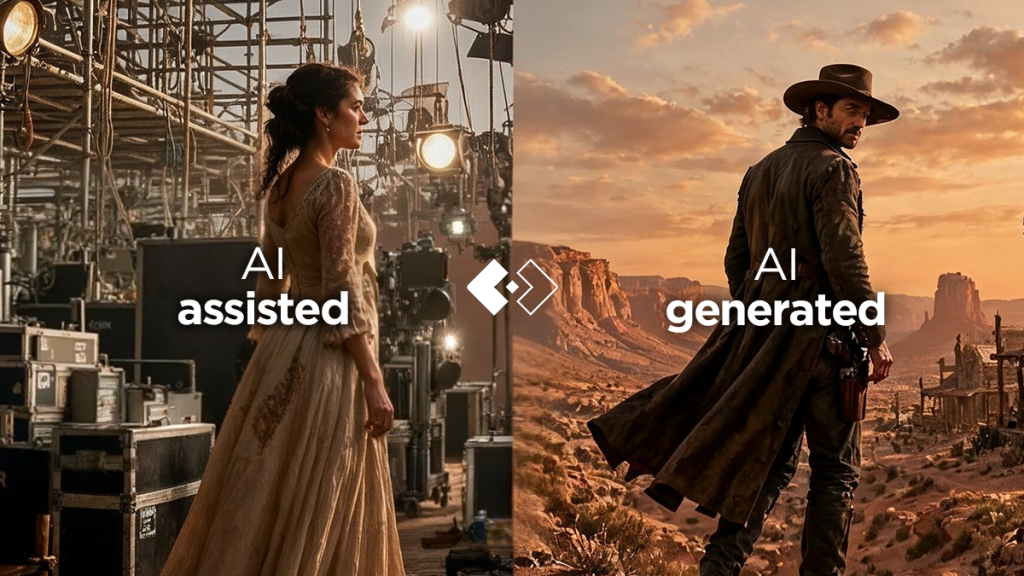
The most useful distinction in this conversation isn’t between “AI” and “not AI.” It’s between AI-assisted and AI-generated.
AI-assisted means humans lead, AI accelerates. The script is written by a person. The shoot is directed by a person. The edit is shaped by an editor. AI tools handle transcription, asset generation, color matching, version control, B-roll. The human creative judgment is intact at every decision point.
AI-generated means the output is created by a model with minimal human shaping beyond a prompt. This works for certain creative briefs, often surreal or stylized ones, where the lack of human nuance is part of the aesthetic. It does not yet work for most brand storytelling.
Most of what brands actually need sits firmly in the AI-assisted category. The studios doing this well are using AI to remove friction from the parts of post-production that used to slow everything down, while protecting the creative decisions that actually matter.
What clients should be asking
If you’re commissioning video work in 2026, the questions worth asking your studio are different from what they were two years ago.
Ask which parts of the process use AI. Ask what stays human and why. Ask how the studio thinks about disclosure if AI is used in any visible way. Ask whether the team can show you a project that combined both approaches well.
The answers will tell you whether you’re working with a studio that’s thinking carefully about this or one that’s just hoping the topic doesn’t come up.
Where we sit
At Multilayer, we use AI tools in the parts of post-production where they make our team faster and free up time for the work that actually requires judgment. Color, sound, editorial choice, narrative structure, client collaboration. Those stay human, because that’s where the value is.
We think the studios that do well over the next few years will be the ones that integrate AI carefully, are honest about what they’re using and why, and resist the pressure to use it in places where it doesn’t actually help. The pressure to use AI for everything is real. Most of it is from people selling AI tools.
The work still has to be good. That part hasn’t changed