
You Shot One Video. Here’s How to Get Ten Pieces of Content Out of It.
Most brands walk away from a video shoot with one deliverable.
A hero film, maybe a shorter cut for social, and a hard drive full of footage that never gets opened again.
That is not a production problem. It is a planning problem. And it is one of the most consistent ways brands leave real value sitting on the table after investing in video.
This piece is a practical guide to modular video production: what it is, how the best brands in the world approach it, and how to brief a shoot so that post-production becomes a multiplier rather than just a finishing step.
What Modular Video Production Actually Means
Modular video production means planning a shoot from the start with multiple outputs in mind, not one.
Instead of briefing a production as “we need a two-minute brand film,” a modular approach asks:
- What are all the ways this footage could be used?
- What formats do we need?
- What platforms will this live on?
- What internal, external, paid, and organic uses exist for this material?
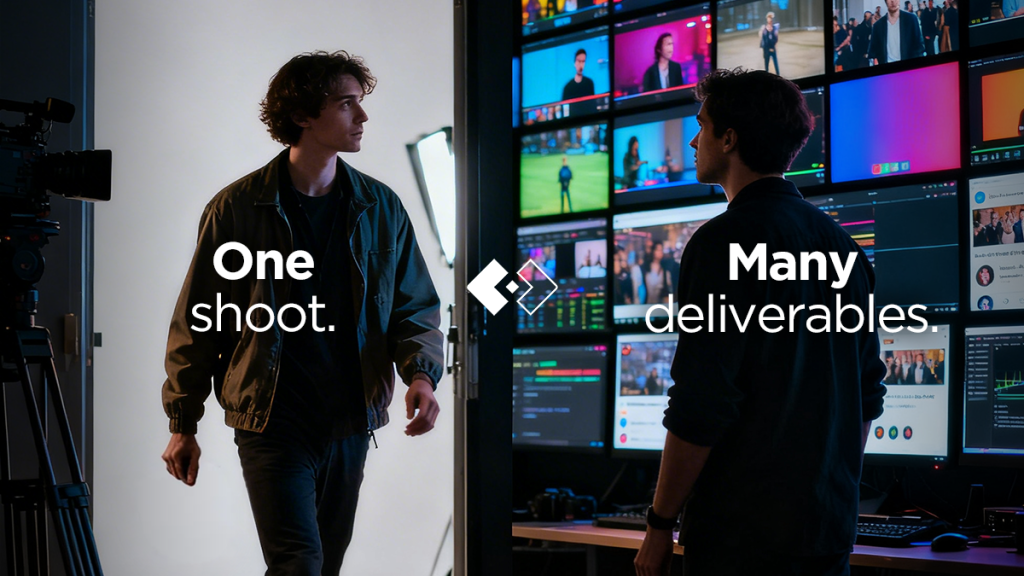
The answers to those questions shape what gets captured on set, how it gets captured, and how post-production approaches the edit. The result is not one video. It is a content system built from a single production investment.
This is not a new concept. It is just not how most brands brief their video work. Yet.
How Red Bull Does It
Red Bull is the most cited example of modular content thinking at scale, and for good reason.
When Red Bull produces an event, a stunt, or an athlete’s story, the production is not designed to create one piece of content. It is designed to feed an entire content ecosystem. From a single Red Bull event, their team produces a live broadcast, a long-form documentary edit, short social clips, athlete POV cuts, behind-the-scenes footage, editorial photography, and written content, all from the same source material.
Critically, none of that happens by accident. It is planned before the camera rolls. The shoot list, coverage plan, and capture approach are built around the full range of outputs the team knows they will need.
Red Bull Media House, the company’s dedicated content arm, has been operating this way since 2007. The result is a brand that produces an extraordinary volume of content without commissioning an extraordinary number of separate productions. They capture once and distribute everywhere.
The lesson is not that every brand needs a media house. It is that thinking about distribution before production begins changes everything about how much value you extract from a shoot.
How Airbnb Approached It
Airbnb’s 2025 Experiences campaign relaunch is a more accessible example for brands that are not operating at Red Bull’s scale.
The campaign centered on a hero film that reframed travel. But the production was planned from the brief stage with repurposing built in. Alongside the hero film, the team produced city-specific social videos for Paris, Tokyo, Seoul, and Mexico City, each connecting directly to bookable experiences inside the app.
These were not separate productions. They were outputs from a single creative system, shot with distribution in mind from day one. The hero film established the visual language, tone, and narrative approach. The city-specific pieces applied that system to specific markets and contexts.
The result was a campaign that felt cohesive across every platform and touchpoint, because it was designed that way from the start rather than adapted after the fact.
Why Most Brands Do Not Work This Way?
If modular production is clearly more efficient and more valuable, why is it not the default?
A few reasons come up consistently.
The brief starts too late. By the time a production brief reaches a studio, the distribution strategy is often not fully resolved. Nobody has mapped out every platform, format, and use case the footage needs to serve. So the brief asks for the obvious deliverable, the hero video, and everything else becomes an afterthought.
Post-production is treated as a finishing step rather than a strategic phase. When a studio only receives a brief for a specific deliverable, they optimize for that deliverable. They are not in a position to say, “This footage could also give you X, Y, and Z if we approach the edit differently.” That conversation has to happen earlier.
Repurposing is an afterthought. Many brands come back weeks after delivery, asking whether existing footage can be cut differently for a new campaign or a new platform. Sometimes it can. Often, the footage was not captured with that use in mind, so the options are limited. The window to capture modularly has already passed.
The fix is simple in principle. It just requires a different conversation at the brief stage.
How to Brief a Modular Shoot?
Before a production begins, the brief should answer a few questions that most briefs skip entirely.
Where will this content live? Not just the hero video, but every potential output. Social, website, internal communication, paid advertising, sales enablement, events. Map the full distribution landscape before the shoot is planned.
What formats do you need? Horizontal for the website and YouTube, vertical for Reels and Stories, square for certain social placements. These have different safe zones, different pacing requirements, and different capture needs. Knowing them up front changes what gets filmed and how.
What moments need to be captured beyond the main narrative? B-roll that serves multiple edits. Interview answers that can stand alone as short-form clips. Reaction shots, establishing shots, and detail shots that give the editor options. More coverage, captured intentionally, creates more possibilities in post.
Who is the post-production partner, and when are they involved? The earlier a studio is involved in production planning, the better positioned they are to advise on capture strategy. A post-production team that knows the full range of intended outputs can shape how footage gets captured to serve all of them.
What is the versioning plan? How many cuts are needed, in what formats, for what contexts? A modular brief includes a versioning matrix, not just a description of the hero deliverable.
What Post-Production Makes Possible.
When footage is captured with modular distribution in mind, post-production becomes significantly more powerful.
A single long-form interview can produce a series of short-form clips, each built around a specific point or moment. A brand film can be cut into a 30-second social version, a 15-second paid ad, a silent-first version for auto-play contexts, and a longer director’s cut for the website, all from the same edit.
Color grading and sound design done once on the hero cut can be applied consistently across all versions, maintaining visual and tonal coherence without duplicating effort.
Motion graphics and titles, designed once with the full versioning plan in mind, can be adapted for each format without starting from scratch.
The post-production investment, when spread across ten outputs instead of one, produces dramatically better value per piece of content. And the content itself is stronger because it was designed as a system, not assembled as an afterthought.
The Shift Worth Making
Brands that treat video as infrastructure rather than a one-off project are already thinking this way. They plan shoots around distribution. They involve their post-production partner early. They brief for the full range of outputs, not just the hero deliverable.
The ones that do not are consistently leaving content on the table, footage that could have served three more campaigns sitting unused on a drive somewhere.
The shift does not require a bigger budget. It requires a better brief and an earlier conversation.
One photo shoot. Ten pieces of content. It starts before the camera rolls.