
AI in Post-Production
What It Can Do, What It Can't, and What That Means for Your Next Project
A conversation is happening in every editing suite, every agency meeting room, and every production Slack channel right now.
Is AI going to change everything?
Short answer: It already has. But probably not in the way most people think.
AI in post-production is not a threat or a miracle solution. It is a shift that is changing how work gets done, where time is spent, and what still needs human judgment. If you work in video production or hire others to do it, understanding this change is now essential.
Let’s cut through the noise and talk about what’s actually happening.
What AI Video Editing Can Actually Do Today
Let’s start with the real story about AI, not just the headlines.
AI editing tools are genuinely useful for a specific category of tasks: the ones that are time-consuming, repetitive, and don’t require creative judgment. That’s not a small thing. In most post-production workflows, those tasks take up a big share of the editor’s time.
Here’s where AI-assisted editing is already making a real difference:
Rough assembly. AI can scan raw footage, identify usable takes, and generate a first assembly cut in a fraction of the time it would take by hand. It’s not a finished edit, but it’s a starting point that saves time.
Transcription and dialogue sync. Automated transcription for video has become fast, accurate, and genuinely reliable. Finding a specific line, syncing multi-camera dialogue, and generating subtitles. Tasks that once required patience now take minutes.
Color grading suggestions. AI color grading tools can analyze footage and apply baseline corrections with remarkable consistency. For editors working across large volumes of content, this alone changes the pace of work.
Audio cleanup. Background noise removal, level balancing, basic sound cleanup, and automated video editing handle these technical passes cleanly, leaving editors to focus on the more nuanced sound decisions.
Repetitive formatting. AI easily handles resizing for different platforms, reformatting aspect ratios, and generating multiple versions of the same cut. AI tools for video editors handle this kind of work easily.
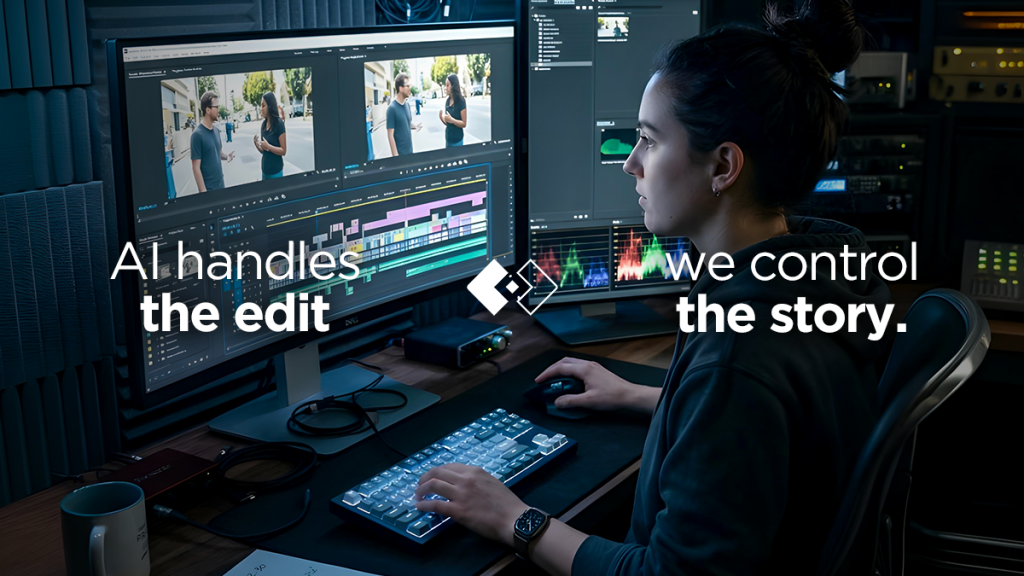
What AI Still Can't Do in a Post-Production Workflow
Here’s where the conversation gets more interesting.
AI-assisted editing is good at processing. It is not good at thinking. And post-production, at its core, is a thinking discipline.
What does that mean in practice?
It can’t understand the brief. AI doesn’t know what the video is trying to do. It doesn’t know whether the goal is to make someone feel, understand, or do . It can’t weigh one edit against another based on strategic intent.
It can’t feel when something’s off. Experienced editors develop instincts over the years. A sense that a cut lands wrong, a moment needs more room to breathe, a scene is working against the story rather than with it. That’s not pattern recognition. That’s judgment. And AI and video storytelling don’t mix the way human intuition and storytelling do.
It can’t manage client relationships. Understanding what a client actually means (versus what they literally said), reading feedback correctly, and knowing when to push back and when to adapt. These are human skills that sit at the heart of what makes post-production for agencies work well.
It can’t make creative decisions when things are unclear. Real projects rarely arrive with perfect briefs and clear direction. The ability to navigate incomplete information and still make good decisions is irreplaceable.
The studios and editors who understand this distinction between what AI can do in video editing and what requires human creative direction are the ones who are using these tools well. The ones who don’t are either over-relying on automation or avoiding it out of unnecessary caution.
What AI Tools for Video Editors Mean for Studios
If you’re on the client or agency side, understanding AI’s role in post-production helps you work with studios more effectively and set more realistic expectations.
A few practical things worth knowing:
Faster doesn’t always mean better. AI editing tools can accelerate the post-production process for agencies, but the decisions that make a video actually work still take time. Compressing the timeline doesn’t change that.
The brief still matters more than anything. No amount of AI in the editing suite compensates for a brief that hasn’t resolved the fundamental question of what a video is supposed to do. That clarity has to come from the client side. AI can do a lot, but it can’t fix what the brief got wrong.
Ask about workflow, not just tools. The most useful question to ask a post-production partner isn’t “Do you use AI?” It’s “how do you use AI, and where does human judgment take over?” That answer tells you a lot about how a studio thinks.
The Honest Take on Where This Is All Going
AI in post-production isn’t just a passing trend; it’s here to stay, and its pace is only picking up.
What it’s doing and will continue to do is separate the technical from the creative more clearly than ever before. The mechanical parts of video post-production are becoming faster, cheaper, and more automated.
The human side of post-production is becoming more valuable than ever.
That’s actually a good thing for everyone who cares about the quality of the work.
The editors and studios that will thrive aren’t those who resist AI or those who outsource everything to it. They’re the ones who are clear about what they bring to a project that a tool cannot, and who use AI-assisted editing to make more room for exactly that.
Every edit still needs a human touch, and every story always will.